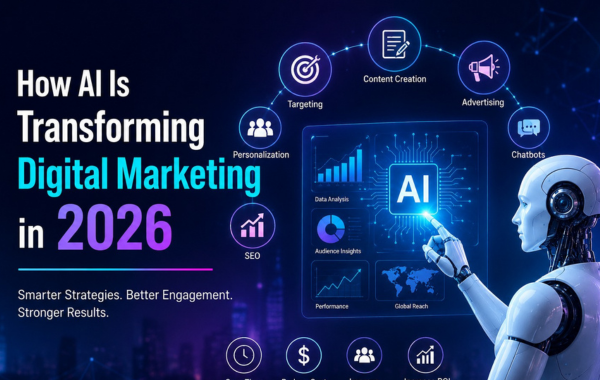
How AI Is Transforming Digital Marketing in 2026
Artificial Intelligence (AI) has become one of the most powerful technologies shaping the digital marketing industry in 2026. What was once considered a future technology is now an essential part of everyday marketing activities. From content creation and search engine optimization (SEO) to customer support, advertising, personalization, and data analysis, AI is helping businesses market their products and services more efficiently.
The biggest change in 2026 is not simply that marketers are using AI tools. Search engines and users are also using AI to discover information, compare products, and make decisions. This has created new opportunities and challenges for businesses. To remain visible online, marketers now need to optimize their content not only for traditional SEO but also for Answer Engine Optimization (AEO) and Generative Engine Optimization (GEO)
In this article, we will explore how AI is transforming digital marketing in 2026 and how businesses can prepare for an AI-powered future.
1. AI Is Making Digital Marketing More Personalized
One of the biggest benefits of AI in digital marketing is personalization. Modern customers expect businesses to understand their interests, preferences, and needs. AI helps marketers analyze large amounts of customer data and deliver more relevant experiences.
For example, AI can analyz
Previous purchases
 Website browsing behavior
Search history
Email interactions
Social media engagement
Customer preferences
Using this information, businesses can recommend relevant products, create personalized email campaigns, and display customized advertisements.
Instead of showing the same message to every customer, AI allows marketers to deliver the right message to the right person at the right time. This can improve customer engagement, conversion rates, and overall customer satisfaction.
In 2026, personalization is no longer limited to adding a customer’s name to an email. AI-powered personalization can change website content, product recommendations, offers, and marketing messages based on individual user behavior.
2. AI Is Changing SEO Strategies
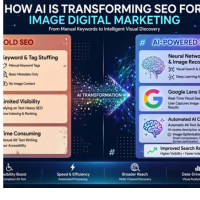
Search Engine Optimization remains one of the most important parts of digital marketing, but AI is changing how SEO works.
Traditional SEO focused heavily on keywords, backlinks, meta titles, and rankings. These elements are still important, but search engines have become much better at understanding user intent and content quality.
AI-powered search systems can analyze:
The meaning of content
User search intent
Topic relevance
Content quality
Expertise and trustworthiness
Relationships between topics and entities
Because of this, keyword stuffing is no longer an effective strategy. Businesses need to create genuinely helpful, accurate, and well-structured content.
How AI Helps With SEO
AI tools can help marketers with:
Keyword research
Search intent analysis
Content outlines
Topic clustering
Meta title and description suggestions
Content optimization
Technical SEO analysis
Competitor research
However, AI-generated content should not simply be published without human review. Businesses should add original insights, real experience, accurate information, examples, and expert knowledge.
The best SEO strategy in 2026 is to combine AI efficiency with human expertise
3. GEO Is Becoming Important for AI Search
Generative Engine Optimization (GEO) is becoming an important part of digital marketing because users increasingly receive answers from AI-powered search experiences and generative engines.
GEO focuses on making content easier for AI systems to understand, evaluate, and potentially use when generating answers.
Unlike traditional search results, generative AI may summarize information from multiple sources. Therefore, simply ranking for a keyword may not be enough. Businesses also need to build content that demonstrates authority and provides clear, reliable information.
GEO-Friendly Content Should Include:
Clear answers to important questions
Accurate facts and statistics
Well-organized headings
Strong topical authority
Original research or insights
Relevant examples
Authoritative sources
Clear information about products and services
For example, instead of creating a page that only repeats the keyword “best digital marketing agency,” a GEO-friendly page could explain the services offered, industries served, marketing process, experience, case studies, pricing factors, and frequently asked questions.
The goal is to become a useful and trustworthy source of information that AI systems can understand.
4. AEO Is Helping Businesses Win Voice and Answer-Based Searches
Answer Engine Optimization (AEO) focuses on optimizing content so that search engines, voice assistants, and AI answer systems can provide direct answers to users.
People are increasingly searching with complete questions such as:
What is AI in digital marketing?
How does AI improve SEO?
Which AI tools are useful for content marketing?
How can small businesses use AI for marketing?
AEO-friendly content should provide clear and direct answers to these questions.
Best Practices for AEO
To optimize content for answer engines, businesses should:
1. Use question-based headings.
2. Give a direct answer immediately after the heading.
3. Keep important answers clear and concise.
4. Use lists and bullet points where appropriate.
5. Add FAQ sections.
6. Use structured data when relevant.
7. Write in natural and conversational language.
For example:
What is AI in digital marketing?
AI in digital marketing refers to the use of artificial intelligence technologies to automate, analyze, personalize, and improve marketing activities such as SEO, advertising, content creation, customer service, and email marketing.
This format makes it easier for users and AI-powered systems to understand the answer quickly.
5. AI Is Transforming Content Marketing
Content marketing has changed significantly because of generative AI. Marketers can now use AI to brainstorm topics, create outlines, summarize research, generate first drafts, and repurpose existing content.
For example, a single blog article can be transformed into:
Social media posts
Email newsletters
Video scripts
Short-form content
FAQs
Infographics
Podcast topics
As a result, businesses can create multiple forms of content and share them across different platforms in less time.
At the same time, the widespread use of AI content tools has made the digital space more competitive, as more businesses can now publish content at a faster pace.The internet is now filled with similar articles created using similar prompts. Therefore, businesses need to focus on originality.
The most successful content in 2026 combines AI assistance with human creativity, personal experience, expert opinions, and original research.
6. AI Is Improving Paid Advertising
AI is also transforming paid advertising platforms such as searchads and social media advertising.
AI can help advertisers analyze audience behavior, optimize bids, identify high-performing audiences, and improve campaign performance.
AI-powered advertising can assist with:
Audiencetargeting
Ad copy creation
Budget optimization
Bid management
Creative testing
Performance prediction
Conversion analysis
Marketers still need to provide strategic direction. AI can optimize a campaign, but businesses must define their target audience, brand message, goals, and overall marketing strategy.
The future of advertising will involve marketers working with AI systems rather than manually managing every small task.
7. AI-Powered Chatbots Are Improving Customer Experience
AI chatbots have become much more advanced in 2026. Businesses can use conversational AI to provide instant customer support, answer common questions, recommend products, and guide visitors through a website.
An AI chatbot can operate 24/7 and respond to multiple customers simultaneously.
For example, a digital marketing agency can use an AI chatbot to answer questions such as:
What services do you provide?
How much does SEO cost?
Do you provide Google Ads services?
How can I contact your team?
This improves response speed and can help businesses capture more leads.
However, businesses should provide human support for complex, sensitive, or high-value customer interactions. The best customer experience often combines AI automation with human assistance.
8. Data Analysis Is Becoming Faster and Smarter
Digital marketers work with large amounts of data from websites, advertisements, social media platforms, email campaigns, and customer interactions.
AI can process this information faster and identify patterns that humans may miss.
AI-powered analytics can help answer questions such as:
Which marketing channel generates the most leads?
Which content topics perform best?
Which audience is most likely to convert?
Why did website traffic increase or decrease?
Which campaign requires optimization?
This allows businesses to make more data-driven marketing decisions.
Instead of spending hours manually analyzing reports, marketers can focus more on strategy and implementation.
9. The Future of Digital Marketers Is Not Replacement but Transformation
One common concern is that AI will completely replace digital marketers. In reality, AI is more likely to transform marketing roles rather than eliminate the need for marketers.
AI is excellent at automation, data processing, pattern recognition, and generating initial ideas. However, human marketers are still needed for:
Strategic thinking
Creativity
Brand positioning
Understanding customer emotions
Ethical decision-making
Building relationships
Creating original ideas
The most valuable digital marketers in 2026 are those who understand both marketing fundamentals and AI technology.Conclusion
AI is transforming digital marketing in 2026 by making marketing faster, smarter, more personalized, and more data-driven. From SEO and content marketing to advertising, analytics, and customer service, artificial intelligence is influencing almost every part of the digital marketing process.
To succeed in this new environment, businesses should focus on SEO, AEO, and GEO together. Traditional SEO helps content become discoverable in search engines, AEO helps businesses provide direct answers, and GEO helps create content that can be understood and recognized by AI-powered generative search systems.
The future of digital marketing is not about choosing between humans and AI. It is about combining human creativity, expertise, and strategy with the speed and intelligence of AI. Businesses that learn to use AI responsibly while continuing to create helpful, original, and trustworthy content will have a stronger competitive advantage in the digital world.